Thursday, 31 October 2013

Yet to be realised

We have just been set a small task called 'Yet to be realised' which was described to us as Chinese whispers with photography.

"You are all required to produce 1 x image that will ultimately form part of a wider narrative. The ‘whole’ of which is yet to be fully realised.
In its simplest sense, your assignment is based upon a form of visual ‘Chinese Whispers’. In reality you are taking part in an exercise with regard to the creation of a collective visual narrative. 
This is a narrative, which is yet to unfold, is unpredictable, and by its very nature is one that will be ultimately influenced by you and your fellow peers as a body of considered and reflective practitioners.
Importantly your narrative must possess ‘cohesion’ in respect to your own personal aspirations whilst ideally affording sufficient ‘room’ for interpretation by your fellow peers and the groups holistically shared interpretations. Namely to create a series of images which although conceived and derived at independently ultimately lend themselves to the formulation and creation of a visual lens based narrative.
          BRIEF / RULES OF PLAY
Stage 1
Students will each be afforded a minimum of 1 x day in order to capture, gather or collate their own personal image, which will ultimately form part of the overriding final narrative. Images can be either from the student’s own archive / portfolio, identified or found online or can be an image which they have decided to capture for this specific assignment. N.B. Your chosen image ‘must’ hold / possess narrative possibilities in terms of its potential reading. 
Stage 2
Each student then must write a brief synopsis, which outlines the following:
a. Reasoning as to why they have captured / chosen their image
b. Their personal reading of that image - denotation & connotation
b. Explain how and why this image possesses narrative qualities
c. Briefly describe how they personally see / envisage this narrative developing 
Stage 3
Students are then required to printout 1 x copy of their image and 1 x copy of their synopsis. Each student must then place 1 x copy of their image and 1 x copy of their synopsis in a sealed envelope (these will be provided at the initial briefing) and submit this envelope to a member of staff in the photography office with their ‘name & group clearly printed on the front of the envelope."

I was mid way in our group so I was conscious that my image could change everything. There wasn't a lot I could do until I received my image from someone else but once I'd received it I had 24 hours to forward and image I felt was similar to it with narrative potential.


The above was the image I'd received. There wasn't a lot of information in the shot and so I picked up on the fence. It looks like fencing used by building sites and disused buildings. I decided to take a risk and find a picture of an abandoned space. My thinking behind it that whoever was in the original photograph could be trying to get into an old warehouse to have a look around, the fence was to either keep someone in, or keep people out.


This was the image I decided to use, found courtesy of google. It really stuck out when I saw it, the complexity of the roof supports was highly contrasting to the empty space in the lower two thirds.

I had to write a brief synopsis to go along with my shot:

"Yet to be Realised Brief

The image I received made me think of someone in a place they shouldn’t be. I felt like it was someone trying to gain access into a building or area to explore or resolve a situation.

I felt that this image was a good way to show an environment where someone would feel alone. It’s baron and clearly disused. This adds to the story I imagined of someone exploring a forbidden space. However there is nothing of major interest within this space so it would lead on to more questions about why someone would be there. Would they be looking for something further along or is what they were looking for gone?

I think the narrative could go in many directions from here. The scene is open to interpretation by the viewer, is there something more to investigate or is it a journey of exploration?

Personally I imagine someone to explore further into the space and stumble across something. That something could be a physical thing or an emotion. From the earlier image I had a sense that it was someone looking back into a time in there past. Possibly stood outside the fence of somewhere they grew up as a child or have some ties to. I think my image takes this further and shows the inside of a space and the narrative could develop to show the personal ties to the place or the reasons for returning. I personally imagine it as someone returning to a place from there past to gain closure of some sort."


Sunday, 6 October 2013

Cropping Assignment

We've been set a small assignment based around cropping, we touched on this with Jason in this weeks session and it was quite interesting. We did a small cropping exercise in groups using printed off photos and it was good to discuss how we would each crop the image and what effect that would add.

We also touched on Vivan Maier's work and how her images were cropped. I found this very interesting and it was brought up that John Maloof, the man who discovered her images, may be cropping images in ways in which Maier never intended. This is an argument that can never be settled based around her work but it is also common practice for Magnum photographers to require there images not to be altered in any way for publication without the photographers written permission. I suppose this is to cut down on publishers uses photos to put a message across in which the photographer never intended.

We were shown 3 shots of Edward Kennedy in a well known publication in 1972. There were 3 editions released each one showing a cropped version of a photo, each showing a very different thing. The original photograph was Kennedy and a priest and one version was a very tight crop of the two showing what a good man he was and that he was a man of god. The next crop was of him and a woman in the background conveying that they were together, this was used alongside a story about Kennedy being a womaniser etc and the final crop was a tight crop of him. Each crop was used to convey a particular message to the audience and with the use of cropping you can selectively choose what your audience sees and there for influence there views.


  • Improve photographic composition or balance of an image - For this image I decided to crop the edges in and remove unnecessary parts from the image. I don't think the sides were adding anything to the image and they were just distracting from the action. When shooting this image I should have shot in portrait in hindsight to avoid having to crop. 


  • Highlight or 'zoom' in on a particular aspect or subject matter within the image in order to create drama and or increase or add visual intensity to an image. - I chose a tight crop on the people in this frame to turn the focus to woman staring at the man rather than the reflection in the original photo. It looks as if the woman has stopped in front of a bus which adds some tension to the image and the man in the foreground is in the same stance and the man in the background on the crossing which I thought was interesting and another reason I chose this crop.


  • Change the aspect ration and by doing so increase its visual weight, presence or import. -

1x1

I cropped this image in 1x1 because I felt that the people should be much more focused in the image. The original felt like you were peering into the action from a distance but with the crop I think you are placed closer to the subjects and seeing the mans facial expression leaves me wondering what exactly is happening. The girls seem to be holding there hands up for expression, I could imagine they were having fun but the man looks very serious and his arms are rigid. I wanted to show this in the photo and add an air of mystery.


5x7

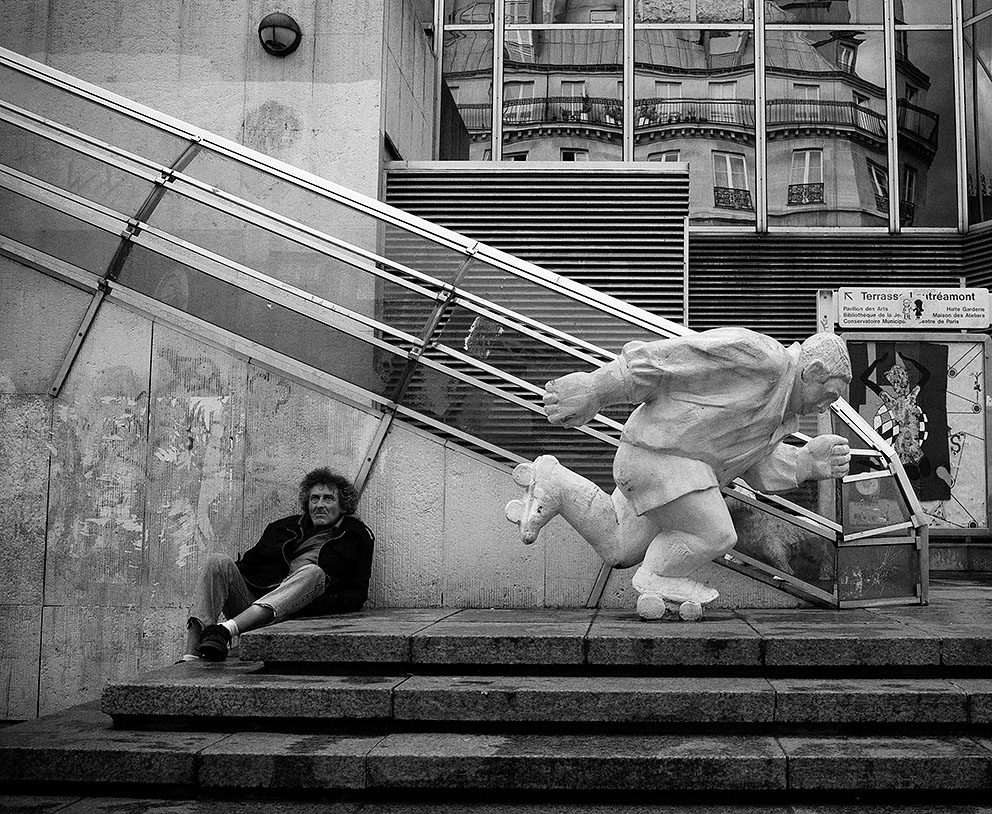
I cropped this to remove the reflections from the window. I found these distracting and wanted to take any clues about the location out of the photo. I also think the lines look much cleaner and the steps lead you into the statue and the negative space on the left makes you notice the man in a very different pose to the statue.


16x9

I wanted to change the focus of this image from the general scene of the train and 3 subjects to a focused image of 2 subjects mainly the woman in the foreground who looks worried, which is a contrast to the young child on the bike who is leaving the train. 


  • Change the focus of the image and by doing so control the eye of the reader of this image. - I decided to take the focus away from the ocean and focus on the cliff itself. I think the orange sky makes the lighthouse stand out and would leave the audience wondering where the ocean was in relation to the lighthouse and what time of day it was.


  • Change the reading or intended message of the image simply by cropping. - I have tried to change the focus in this image from the woman outside to the child inside. By cropping out the sides it gives the illusion that you're right in the doorway peering inside and you've been met with the eyes of the young child. I would find my self questioning why she was alone when in fact from the original crop it's clear she is not.


Tuesday, 1 October 2013

Interpreting images


This was an exercise to get us thinking about words and ways to describe images without being too in depth. We were told to first say what we saw. It sounds easy but it was quite difficult to begin with. We were literally saying words like' Door', 'Floor' and 'Stairs'.

We then had a chat with Jason about where the image could be and this opened a new world of ideas. We suggested it could be a door in a nightclub, the floor was quite dirty and the door has seen some action. We then began to think about perspective again opening up new ideas. It could be a lost child, someone who has fallen over or simply someone trying to hide. The ajar door led us to question was someone hiding behind it or trying to escape?


This image was the basis of a similar discussion. Once we got going it was a really good exercise. There were no right or wrong answers so we were just throwing ideas together as a group and we came up with some great possibilities for the motive of the shot.


We did the exercise for several images and then came together as a larger group to discuss what we thought and every group had different things for each image which was interesting!